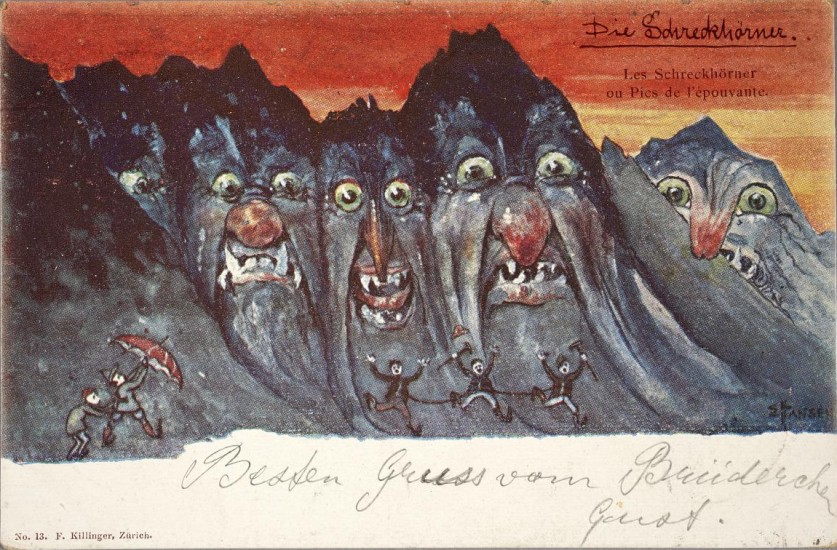

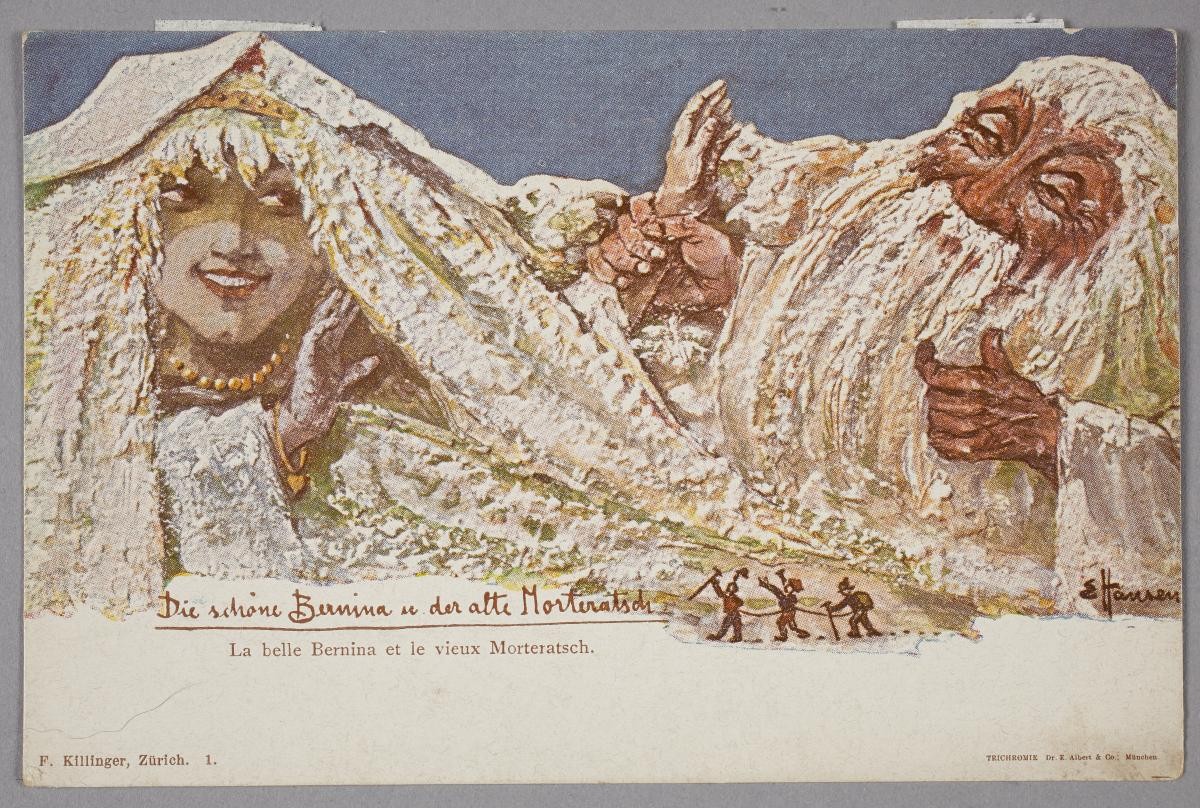
Emil Nolde, The Beautiful Bernina and the Old Morteratsch, 1897. Photomechanical print on paper, 9 x 14 cm. Purchased as a Gift of the Trier-Fodor Fund, 2012. © Nolde Stiftung Seebüll, Germany.
In the late 1800s, long before social media, the fastest way to greet a friend was to send a postcard. German artist Emil Nolde (1867–1956) was one of the pioneers in the design of early picture postcards.
Born Emil Hansen, in 1902 the artist adopted the name of his birthplace, Nolde, a small town on the German-Danish border. In 1896 he was living in St. Gallen, Switzerland, and created over 30 humorous images depicting the Alpine peaks of the region as caricatures based on the mountains’ nicknames. The images proved so popular they were distributed in the thousands in Germany and beyond. The proceeds from the sales allowed Nolde to move to Munich and dedicate himself fully to his art.
In 1906, he became a member of Die Brücke (The Bridge), a group of German Expressionist artists who rejected the realist approach of their predecessors and used colour, line and form in symbolic, emotive ways. The impulse to attribute human feelings to non-human subjects would continue to inform Nolde’s mature landscape paintings, imbuing them with extraordinary expressive power.
This set of postcards are part of the AGO’s special collection of caricatures and humorous art purchased over the last 40 years thanks to the Trier-Fodor Foundation.