
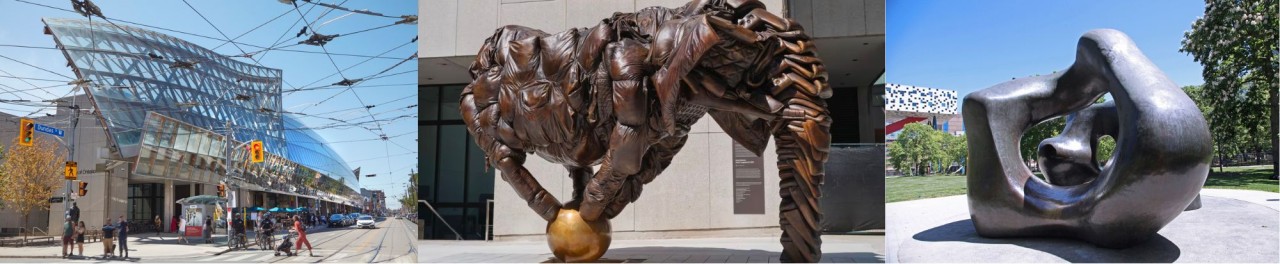
Left to right: Frank Gehry. Transformation. Building facade, glass and wood. | Brian Jungen, Couch Monster: Sadzěʔ yaaghęhch’ill 2022. Bronze. Collection of the Art Gallery
of Ontario. 2022/1. | Henry Moore. Henry Moore's Large Two Forms. Bronze.
Left to right: Frank Gehry. Transformation. Building facade, glass and wood. | Brian Jungen, Couch Monster: Sadzěʔ yaaghęhch’ill 2022. Bronze. Collection of the Art Gallery
of Ontario. 2022/1. | Henry Moore. Henry Moore's Large Two Forms. Bronze.
Explore the AGO facade and the artworks outside the building, Henry Moore's Large Two Forms and Brian Jungen's Couch Monster: Sadzěʔ yaaghęhch’ill.
Audio recorded verbal descriptions provide an accessible and detailed narrative to extend your experience of the AGO. These descriptions, rich in detail and sensory language, provide a vivid exploration of form, texture, and artistic intention, ensuring that all visitors can engage deeply with these celebrated pieces of architecture and public art.
00:00
Brian Jungen, Couch Monster: Sadzěʔ yaaghęhch’ill 2022. Bronze. Collection of the Art Gallery
of Ontario. 2022/1.
00:15
Couch Monster: Sadzěʔ yaaghęhch’ill. Saatsónéʔ Danétl’ádze Ontario Dane Aayę́líi Dane
Yekʼááhtíi.
00:28
A plaque with information about the artwork is mounted nearby on the side of the Art Gallery of
Ontario building. It displays text in Anishinaabemowin followed by an English translation. This
recording also offers the text in Dane-zaa. A note at the bottom of the plaque reads: please
touch but do not climb the sculpture.
00:53
This is a 13 minute recording. A description of the work will begin in three minutes. The
acoustic environment at Dundas and McCaul streets is loud and vibrant depending on the
season. On any given day, one can hear the persistence of house sparrows, the chatting of
small groups of pedestrians on the move and the intermittent din of vehicles. Dundas Street
has a streetcar or trolley car as its main transit access, and the accelerating and decelerating
of cars make a smooth hum for such a busy street, Dundas has surprising gaps in car traffic
that can offer unexpected intervals of restful quiet. On a weekday, the air might be filled with
the sound of not too distant construction noises. The sloping facade of the AGO building hangs
over the space in front of this work and serves to somewhat soften the cacophony on the
corner.
01:56
An artist of Dane-zaa and European heritage, Brian Jungen, born 1970 is from northern British
Columbia on Treaty 8 territory. Jungen has presented significant solo exhibitions at the AGO ,
and he is internationally renowned for his sculptures and installations made from repurposed
consumer goods. In his extensive body of work, Jungen engages with both indigenous materials
and traditions as well as Western art history and popular culture.
02:33
Entitled Couch Monster: Sadzěʔ yaaghęhch’ill, Jungen's sculpture is a monument to creative
form and engineering. In his first large scale work in bronze, Jungen constructed the figure of an
elephant from discarded leather sofas and relishes the opportunity to surprise visitors. "The use
of discarded couches came from my experiences of walking the streets of Toronto and seeing
them abandoned on sidewalks waiting to be picked up at night", said Jungen. "This was foreign
to me and surprising, but to the residents of the city, accustomed to seeing them, they are
invisible. I look forward to making them visible again." End quote.
03:22
The following is an audio description of the work. This instantly recognizable, dark brown, 4032
kilogram bronze elephant is located outside the north east corner of the gallery on an area of
dark coloured stone. It is highly visible from the intersection it faces and is nestled close to the
gray concrete two story building and its extended front canopy. There are three trees and
several wooden benches around it. In all seasons, this is a popular place for people to sit and
have lunch or take a break. People and families also gather to take a picture with the elephant,
sometimes posed, sitting on its trunk. The massive Couch Monster holds itself horizontal, posed
balanced on a smooth, gold coloured brass ball, just slightly under doorknob height and less
than an eighth of the elephant's length. Its four straight legs are pinched in at impossible
angles and a second balance point its long, thick trunk rests on the ground. The bronze tip
curved upward toward the elephant's left side at an average person's waist height when
standing, is shiny and has been burnished and worn from all the hands that have touched or
rubbed it, and conveys that part of its history. The four meter tall sculpture is as long as a
cargo van and slightly wider.
04:59
Cast in bronze from a plush and cushiony leather form, it has a waxy, warm brown patina or
colouring and a similar luster to leather. It is a revelation to many people to discover its hard
surface, the texture, creases, folds and wrinkles of animal hide, and the details like decorative
buttons, raised stitching and seams where the leather is sewn together are visible and tactile.
The head and trunk are made of at least 21 chairs which are upholstered in leather. The trunk
is made of kitchen chairs which are legless and stacked upside down. The chair backs have a
rounded top and a little opening where the back meets the seat. The chair backs overlap one
another in the stack, which creates a plated armour effect along the front of the trunk. The
stack of seats has been cut through to create the right shape of a trunk tapering as it nears the
ground.
05:57
Couch Monster resembles the African elephant species, which has large ears that are almost
the size of its head. Couch Monster's ears are full size wing back chairs, which are legless and
protrude from the sides of its head. There is enough space for an average height person to
stand underneath the head and feel the back of the trunk and the ears, which hang to average
standing height, head height. There are also two stubs of tusks which stick out extending from
where the elephant's jawline would be. They've been sawed off close to their base, and their
circumference is about the size of a doorknob.
06:37
The underside of the elephant's head is a tufted sofa with a diamond pattern where the
elephant form is not made of chair parts. It is sofa parts. Its legs are sofa arms shaped and
sewn together in a cylindrical tube. The hulking sides of the couch monster are creased leather
sofas that have the stuffing left out the leather drips and sags. This can be discovered by
reaching up on the side of the elephant and on the underside of the belly on the left its back
dips slightly.
07:13
And at the rear of the elephant, low and quite close to the ball, is a section on the back left leg
with a rough seam and stitching where the upholstery has been stitched together to make that
leg. There is also a section of zipper and another of buttons to discover. The elephant tail is
represented in diamond tufted leather sewn on as a cone shape, which hangs near head level
of the standing height of an average person.
07:41
A note on the tactile experience, as written by blind consultant Christine Malik. Many aspects of
the sculpture protrude horizontally, so circumnavigating it needs to be done cautiously. The
immediate first impression of the texture of the sculpture itself is almost papier mache, slightly
rough to the touch and dusty with urban grit. All aspects of the elephant are textured with
swirls and layering to denote the wrinkled surface of elephant skin. The fact that the sculpture
is constructed from furniture is not immediately apparent to the touch, except in certain spots.
For example, part of the elephant chest has the dimpled texture of a couch cushion. Some of
the edges of wrinkles feel clearly like the edges of a chair where tacks have been used in
sequence to secure stitching, although these surfaces share the same dusty texture as the rest
of the piece, one must reach up to touch the underside of the elephant. Its trunk, tusks and
ears protrude horizontally and downward. The tail resembles an icicle in its shape and
orientation, but rather than being smooth to the touch, has the wrinkled texture of the rest of
the sculpture. The elephant is frequently the focus of attention of families and small children
exploring it with their hands.
09:11
Plaque text. To create the prototype for this monumental bronze sculpture, Jungen cut up and
reconfigured several leather couches. He was inspired by the story of Jumbo, a captive circus
elephant who was killed by a train in St Thomas, Ontario in 1885.
09:30
The artist calls this creature a "Couch Monster" because capturing and training an elephant for
the circus involves breaking the animal's will and spirit. An elephant no longer. It becomes a
monster, created by humans for their own entertainment. The works Dane-zaa, subtitle Sadzěʔ
yaaghęhch’ill which translates to "My heart is ripping", reflects the sadness and cruelty of
keeping living beings in captivity. This has been the audio guide with verbal description to Brian
Jungen's Couch Monster: Sadzěʔ yaaghęhch’ill. Keep listening to hear the information on the
wall plaque in the Dana-zaa language.
10:18
You can also explore the Art Gallery of Ontario's architecture by listening to an audio track
about the glass and wood canopy on the building's front facade, designed by architect Frank
Gehry, and be sure to check out the Henry Moore sculpture, Large Two Forms, just south of the
gallery in the Grange Park. Also provided with an audio guide with verbal description and
available on the AGO website.
10:45
Next you will hear the exhibition label text on the plaque in Dane-zaa, translated by Elders Billy
and Gary Attachie and spoken by Madeline Oker, located 3200 km northwest km in Tsaa Chay
Ne Dah-nah territory.
11:03
Saatsónéʔ aghęlíi Jungen dane yak’ih s̲adii yaaghané̱laíi tlʼwą̂ą kʼaahjuu wǫlii nachii kʼé̱tsʼę́
aayę́laaʔ. Tǫhche̱tʼǫ́h St Thomas Ontario wúúye̱ dę 1885, wǫlii nachii mįghǫʔ najé̱ẕe, saastónéʔ
kʼą́ę́tlije yé̱h yaʔé̱htlʼaah, ii ẕáágéʔ ii kughaẕéhṯs̱ʼǫ éh ii dę kʼé̱ʼę́jii chadach. Jungen jii wǫlii
nachii ayę́lááʔ “dane yak’ih s̲adíi chishˮ yéhjiih. Yę́hchuut ii tlʼwą̂ą je̱yęhdan circus waghaa
ẖǫ́hchuu ǫ ii ghadii ęjííʔ tʼáádze wǫlááʔ. Ii wǫlii nachii męghǫʔ najé̱ẕe achʼuu ayę́líi tlʼwâą giiyǫ
adadluch. Dane-ẕaa Ẕáágéʔ “Sadzěʔ yaaghęhch’ilh,” ghajii, Age̱yaas Ẕáágéʔ “my heart is
rippingˮ ghajii. Ké̱tsʼé̱leh wǫlii nachii daahghe̱hṯs̱iit.
12:44
The AGO gratefully acknowledges the following funders for their exemplary support in bringing
this commission to life. Le MBAO tient à remercier les donateurs et subventionneurs suivants
pour leur soutien exemplaire dans la réalisation de cette commande: The Rennet and David
Berman Family Foundation, Charles Brindamour and Josée Letarte, Morey and Jennifer Chaplick,
Bob Dorrance and Gail Drummond, Angela and David Feldman, Government of Canada,
Gouvernement du Canada, Hal Jackman Foundation, Phil Lind and Ellen Roland, TR Megan
Family Foundation, Partners in Art, Paul and Jan Sabourin, Anonymous.
13:32
End of exhibition, label, text, credits, written and voiced by Rebecca Singh of Superior
Description Services with consultation by Christine Malik.
00:00
Henry Moore. Henry Moore's Large Two Forms. Bronze.
00:06
A plaque with information about the artwork is mounted nearby, just west of the sculpture. It
displays text in English and an etched line drawing. This is a seven minute recording. A
description of the work will begin in two minutes.
00:21
This work can be found in Grange Park, a two hectare urban park located behind the Art Gallery
of Ontario. All walkways provide obstacle free routes with non slip surfaces and tactile and
colour signals at the edges, slopes and steps. Service animals are welcome. Large Two Forms
sits on the west side of the park's circular path, surrounded by mature trees on a ground level
base. Tree species include american elm, horse chestnut, beech and oak, among others.
Plantings include vegetation that stimulates the senses of touch, scent and sight. Fountain
grass and lamb's ear plants provide different textures to explore. Flowers are white, yellow and
blue. The acoustics are park like depending on the season, with chirping birds and the sounds
of children playing.
01:18
Henry Moore was born in July 1898 in Castleford, Yorkshire, England. He was an internationally
renowned sculptor of the 20th century. He died in 1986. The Art Gallery of Ontario is known for
its extraordinary and extensive collection of Henry Moore works. The Henry Moore Sculpture
Center at the AGO originally opened in 1974 to house Moore's original gift to the AGO now
totaling more than 900 sculptures and works on paper. This particular work was created
between 1966 and 1969.
01:18
This has been an audio guide with verbal description of the Henry Moore sculpture, Two Large
Forms. You can also explore the Art Gallery of Ontario's architecture by listening to an audio
track about the glass and wood canopy on the building's front facade designed by architect
Frank Gehry, and be sure to check out the northeast corner of the building where you'll find
Brian Jungen's sculpture Couch Monster: Sadzěʔ yaaghęhch’ill also provided with an audio
guide with verbal description and available on the AGO website. Large Two Forms is supported
and sustained by Margaret and Jim Fleck. Credits written and voiced by Rebecca Singh of
Superior Description Services with consultation by Christine Malik and input by James McKenzie.
01:58
The following is an audio description of the work. This large bronze sculpture is nearly four
meters or 12 feet tall and six meters or 20 feet in diameter. About 12 people could encircle it
with their arms out and fingertips touching. The work consists of two abstract forms which
curve over and around one another, a curving passage between them invites curiosity. The
shapes have the smooth contour of a pebble with occasional light scratches and cracks. They
have a dark brown patina with shades of green on parts of the surface area which are oxidized.
The shapes each have a hole through the center of them. The narrowish walkway between the
two forms is sculpted to wrap around in a loose C shape, which provides the explorer with an
intimate encounter with the work from inside. It is possible to watch the goings on in the park
through the holes, or to see the sky overhead, which has a few treetop branches swaying in it.
Many people also climb into the whole opening of the larger form and take a seat or make them
ring out with a sound.
03:18
The two forms are on a dark pavement like surface and are warm to touch in the summer and
snow capped in winter. What the forms visually resemble is a point of fascination among fans of
Moore's work. Some say they are abstract forms with bodily references, and that Large Two
Forms resemble giant pelvic bones sensuously spooning. One thing is clear, the experts
disagree. The forms do appear different from every angle. From one angle, the sculpture is an
amoeba with a hole at its center. From another angle, it is a bent out of proportion circular
shape in front of the lower torso and upper legs of a person and set as if the body part was
about to walk through a portal in front of it. From the side, the two forms are of similar
appearance, like two pairs of abstract legs walking one behind the other.
04:18
The larger of the two forms is located on the north side of the sculpture. Its contours resemble
bone. It is a lazy letter O shape with a squat base, but also tipping forward at the top towards
the smaller form. The opening in the large form is large enough for a tall person to lounge in
with both feet straight out in the wide, high stool height opening. The form's pebble like texture
has been rubbed completely smooth here, and is a light, brassy yellow colour, which reveals
that many people have sat on it. The smaller form is located on the south side of the sculpture.
It is. Shaped like the symbol for pi, which has a tall bar at the top of it and rounded legs that it
stands on. The legs are also joined at the bottom, where there is a small gap between the
shape and the ground in the middle of the form. The opening of the small form is such that an
average size person, if standing, would be able to swing their arm in a circle and brush their
fingers along the edge of it. It is perfectly lined up with the opening in the large form. On the
west side of the sculpture are large old trees, and they provide shady canopy.
05:36
Many members of the public are occupants of the park. The sculpture is rarely alone, even at
night time when it is lit from lamppost that surround it. A note on the tactile experience, as
written by blind consultant Christine Malik. As you approach the sculpture, the surface of the
ground changes to a public playground, like texture underfoot the sculpture is in two parts. The
texture of the brass varies from smooth where it's been contacted by many human hands and
rougher its natural texture. The overall impression is of sweeping curves. There are no sharp
edges. All surfaces feel rounded with several vertical circles that practically beg to be climbed
into. The smooth texture is evidence that people often do climb into them because of its
rounded features and flowing shape. Walking around each piece of the sculpture can be
somewhat disorienting, as it isn't clear when you've circled it completely, it is possible to walk
between the two forms. They are close together, but from ground level by touch, it's difficult to
conceptualize how the two pieces are meant to be viewed separately and together. The bronze
structure is hollow, and knocking or tapping on it produces a surprisingly resonant, airy and
lasting, high pitched sound. End of Audio Description.
00:00
Frank Gehry. Transformation. Building facade, glass and wood. This is an eight minute
recording. A description of the work will begin in three minutes.
00:12
This location has been home to the Art Gallery of Ontario since 1911. The gallery was originally
housed in the Grange, which is on the south side of the building and is the oldest remaining
brick home in the city. The AGO is one of the largest art museums in North America. It holds
more than 120,000 works in its collection, which spans from 100 common era to the present.
When it was built in 2008 the gallery's Dundas Street facade on the north side of the building
was the largest public project in Canada to use wood, and was considered one of the most
complex wooden constructions in North America, since no two of its arches are identical. The
location is adjacent to downtown Toronto's historic Chinatown and the Ontario College of Art
and Design University campus.
01:07
Born in 1929 and raised in Toronto, architect Frank Gehry moved with his family to Los Angeles
when he was 18. He became internationally renowned for his art museums and spectacular
architectural projects around the world. The AGO was the first museum he ever visited, and
also became his first Canadian project. Construction began in 2005 and the transformed gallery
opened to the public three years later.
01:38
From the sidewalk across from the gallery, Dundas feels like a typical Toronto four lane street
with a steady flow of vehicle and pedestrian traffic. People are moving quickly. Down the street
to the west is the beginning of Chinatown, a mixed commercial residential area with mostly two
story buildings and a blast of colourful signs that advertise the many small shops and
businesses along the street. They hang vertically, perpendicular to the buildings, so the
Chinese language characters written top to bottom can be read from down the street. Directly
across from the gallery are brown stones. They are two or three story heritage homes that are
mostly yellow brick with gabled roofs. About half of these have been converted into businesses,
shops, cafes or galleries. Further east along the street is a forest of office towers and high rises
and access to the subway system.
02:37
The gallery side of the street has a more relaxed feeling. There are more likely to be people in
groups, chatting, lingering to wait for friends or look at the art or the AGO itself. The people are
likely to be a mix of local residents and tourists, and will include people of all ages, classes and
abilities who reflect the city's vast diversity. The gallery building itself spans the width of the
entire block between McCaul and Beverly streets.
03:07
Audio description of the work. Frank Gehry's design for the AGO Transformation Project is a
sleek glass exterior facade which covers the entire 200 meters or 600 feet length of the
building's north side, and rises to a height of 21 meters, or 70 feet above street level.
Rectangular and resembling the shape of the curve of the long, narrow body of a sardine fish,
Gehry's design is glistening panes of glass affixed to curved wood timbers that run along the
length of the building on either end. This glass curtain has a tear in the design where half the
height of the structure peels forward as if there's been a rip in it.
03:56
The clear, thick glass is attached to the curved wood in five long rows at the height of the
second and third floors. The entire structure includes about 120 massive vertical timbers which
are held in position by a steel frame. It is suspended like a canopy on the front of the light gray
building. Along the lower edge of the structure is an additional row of glass panes that runs like
a ribbon along the bottom.
04:30
The canopy was designed to be as transparent as possible, so from the street, the wood beams
are visible, and so too are the interior design and people in the gallery looking at art. The top of
the canopy also extends above the roof, and so the sky can be seen both through and around
it, which creates a feeling of unity.
04:54
Generally during the day, the facade appears to be an aluminum grayish hue. It also reflects
the constant motion of the streetscape and neighborhood that it faces in the downward curving
glass from across the street. It is possible to watch traffic travel past on it, and when the light is
right, to make out the brownstones and pedestrians, perhaps even oneself.
05:22
The enclosed portion of the canopy is called Galleria Italia. It spans 137 meters, or 450 feet,
and is described as a wood and glass gallery that provides a contemplative space with a view
of the street below. At night, it is fully on display. The canopy's soaring wood timbers are a
celebrated feature, and the space is outfitted with many more decorative features of the same
honey brown Douglas fir, which is the colour the canopy takes on at night when its lights are
on.Galleria Italia is a popular event space, and so it would not be uncommon for large groups of
people to be mingling there.
06:05
The building itself is set back six meters or 20 feet from the curb. From the sidewalk in front of
the gallery, there are up to six steps up to a covered walkway, which is the underside of the
facade. Its ceiling is spanned by rectangular panels of honey coloured wood, a warm contrast to
the concrete floor of the passageway and the glass facade in the passageway, there are pillars
decorated with banners announcing the exhibitions and a long, gently sloping ramp that begins
on the east end. The walkway gives an intimate, enclosed feeling.
06:41
Here are three entryways. Easternmost is through glass doors outlined in red, marked Bistro.
And on the West End is the school group entrance. Midway through the walkway are the main
doors. And to the left of the three sets of double doors here are huge red three dimensional
letters, A, G and O that reach to door height. These are a popular photo backdrop for groups
and selfie takers. The automated entry doors are on the left, closest to the large red AGO sign
with a door opener button positioned on the handrail at the steps up to the walkway. Buttons to
open interior doors are on the left.
07:22
Immediately after entering the exterior door, entering is an immediate acoustic shift into a
radically quieter but still lively soundscape of people conversing and moving about, a bit like
popping into a very vibrant and very hip library.
07:38
End of Audio Description. This has been the audio guide with a verbal description, exploring the
building's front facade, designed by Frank Gehry. You can also check out the northeast corner
of the building, where you'll find Brian Jungen sculpture, Couch Monster: Sadzěʔ yaaghęhch’ill
also provided with an audio guide with verbal description. Be sure to explore the Henry Moore
sculpture, Large Two Forms just south of the gallery in the Grange Park, with that audio
available by a QR code and on the AGO website. Credits, written and voiced by Rebecca Singh
of Superior Description Services with consultation by Christine Malik.