
The AGO marks 25 years of extraordinary photography
The AGO’s year of milestone celebrations includes an exhibition that honours the 25th anniversary of the museum’s Photography Department. Beginning with founding curator (and now Curator Emeritus) Maia-Mari Sutnik in 2000, this curatorial area has grown exponentially in both size and importance since then, welcoming over 70,000 works into its collection and presenting several remarkable exhibitions.
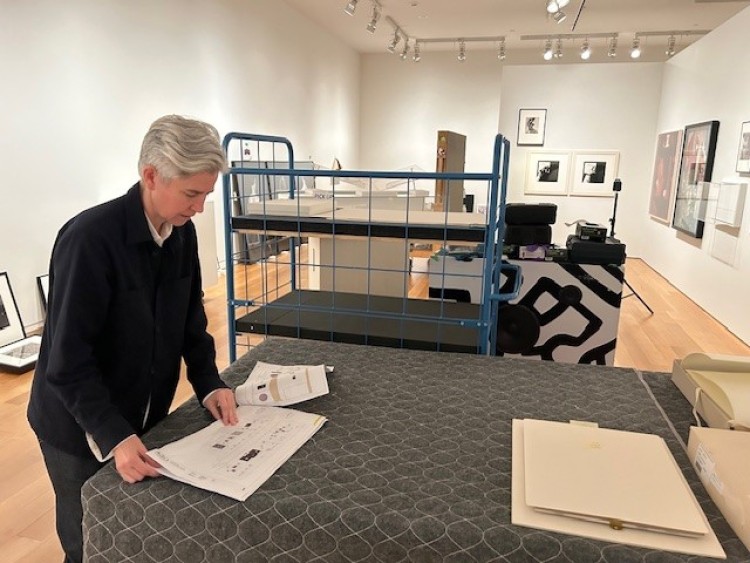
Sophie Hackett, Curator, Photography, installing artworks for the Collective Visions: Celebrating 25 Years of Photography exhibition.
Sophie Hackett, Curator, Photography, has been an important part of the department’s evolution since she joined the AGO in 2006. From working alongside Maia to curating the recently opened exhibition Collective Visions: Celebrating 25 Years of Photography, Sophie has a vivid lens into the past, present and future of photography at the AGO—and shares her insights here.
Q: What are the defining characteristics of the AGO’s Photography Collection?
A: The vision Maia always had was to highlight photography's multiple and interconnected uses: in the artistic realm, but also press photographs, family photographs, photographs created for scientific inquiry, among others. There’s an aesthetic element in each of these kinds of works that we can discuss in art historical terms. I think this is one of the ways our collection stands apart in wholeheartedly representing this range of uses.
Q: How would you describe the Photography Department’s collection strategy?
A: An ongoing part of our collecting strategy is to acquire collections in depth. Some feature a single artist; for example, Joseph Sudek—a donation of over 900 of his photographs is what prompted the formation of the department—or Diane Arbus and Arnold Newman. I also regularly identify a collecting thread as a way to focus our activities and build a story. In the last little while, I've been looking at work from the 1970s and 80s, which is a moment where a new set of strategies and a new set of artists that come to the fore in the field, like Graciela Iturbide, Peter Hujar or Tseng Kwong Chi. Right now, I’m thinking a lot about Toronto and how the collection can do justice to the amazing work that continues to be made here.
Q: Can you talk about the role of philanthropy in building the department.
A: There’s just no way that we would be here without the support our donors have shown over the years. Whether they’ve believed in specific artists or a specific type of photography or in the ideas that we're putting forward, it has taken support and a leap of faith at every stage for the department to thrive.
Q: For Collective Visions, the works were chosen by more than 80 collaborators, including artists, curators, collectors and scholars. Why did you take this approach?
A: I wanted to emphasize that building public collection is a collective endeavour, so I invited people who have worked closely with us here at the AGO, as well as those who have been significant members of our photography scene more broadly, to select a work from the collection as a way of acknowledging their role. The Surrealists courted chance with their collaborative “exquisite corpse” game, where each person chose a work inspired by the one that came before, and this seemed like the right way to focus the assignment. It’s been a joy to spend time with each participant discussing a single work, what strikes them about it, and what dialogue they’d like to build with their selection. The participants brought playfulness, soulfulness, and thoughtfulness to the process, which shines through in the show in so many serendipitous ways.
Q: What makes a great photograph in your eyes?
A: In any medium, an artwork that draws my attention is one that opens up a world or worlds. That can be formally, materially, narratively—there are so many ways that can happen, but to me a great photograph is one that opens up a new world.