
Head of Conservation Maria Sullivan Talks Family, Philanthropy and Her Evolving Profession
Since arriving at the AGO in 1997 as a Samuel H. Kress Fellow, Maria Sullivan has seen the AGO’s Michael and Sonja Koerner Centre for Conservation—and the field of art conservation more broadly—evolve in exciting ways. Now the museum’s Head of Conservation, Maria sat down with us to share details about her family’s connection to the profession, her team’s relocation during construction on the Dani Reiss Modern and Contemporary Gallery, and the role of philanthropy in supporting the work of AGO conservators.
Q: How did you get into the field of art conservation?
A: Conservation is a very small field, and most people don’t know about it. But when I was growing up I made several trips to the Netherlands with my mother, who was Dutch, and visited family who run an art gallery there. My grandfather had been a restorer and my uncle was in the same profession. He was kind of a favourite uncle of mine and he helped me fall in love with it. One of my cousins also worked with him, and around when I was first starting my undergraduate degree, I went there and became interested in the restoration work they were doing and decided it’s what I wanted to do, too. I spent a year working with the two of them, and that’s where I got the experience I needed to get into a Master’s program.
Q: How has art conservation over the years?
A: That’s one of the wonderful things about conservation—it’s always growing and changing. No two artworks are ever exactly the same, so we’re always finding solutions. We’re always learning. For the Joyce Wieland: Heart On exhibition, for example, we started years in advance with research into how to handle the artworks she made with plastics. And about a year and a half ago, we started planning for the installation for the Dani Reiss Modern and Contemporary Gallery and the artworks we’ll need to treat for that.
Q: Speaking of the Dani Reiss Modern and Contemporary Gallery, the Conservation lab had to temporarily relocate to the Sam & Ayala Zacks Pavilion last year because of construction. What was that experience like?
A: We have so much specialized equipment and so many special needs that a lot of thought had to go into the move. It was a big undertaking, just figuring out what we needed for storage, for workspace, electrical requirements, because the gallery space we’re working in wasn’t built for what we do. But with a lot of help from our colleagues we’ve been able to adapt. And it’s not the first time we’ve done it—we also had to relocate for the Transformation AGO construction in the 2000s.
Q: How has the endowment of the Conservation Centre from Michael and Sonja Koerner impacted your work?
A: I’ve been here for decades, and that gift has changed this department in a way that nothing else has. It’s helped us host fellows and ensure that our conservators are able to do professional development, present papers at conferences and stay at the forefront of the field. Having that funding has raised our practice to another level and enabled us to do so much more than we could before.
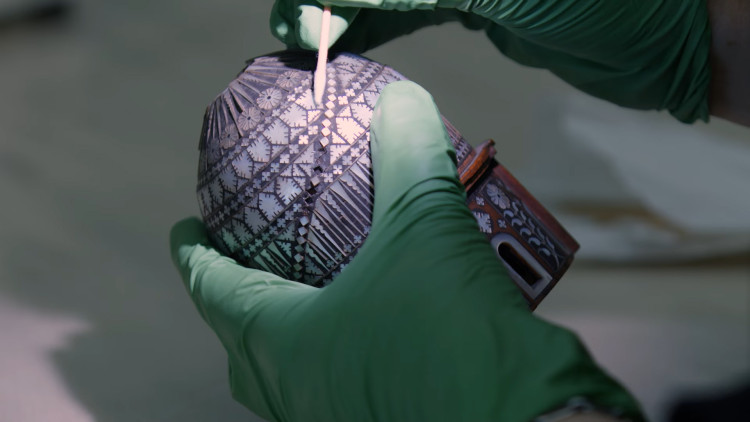
An AGO Conservator works on a 350-year old religious sculpture. Work pictured: Section of tabletop model of the Church of the Holy Sepulchre made by artisans in Bethlehem or Jerusalem, late 1600s. Mother-of-pearl, ebony and blackened wood, Syro-Lebanese work. Overall: 27 × 50 × 45 cm (10 5/8 × 19 11/16 × 17 11/16 in.). Purchase, with funds by exchange from Mrs. J. Morrow, and the Contributing Members’ Fund, 2021.