
Chief Curator Julian Cox On the Boundary-Breaking Work of Ranbir Sidhu
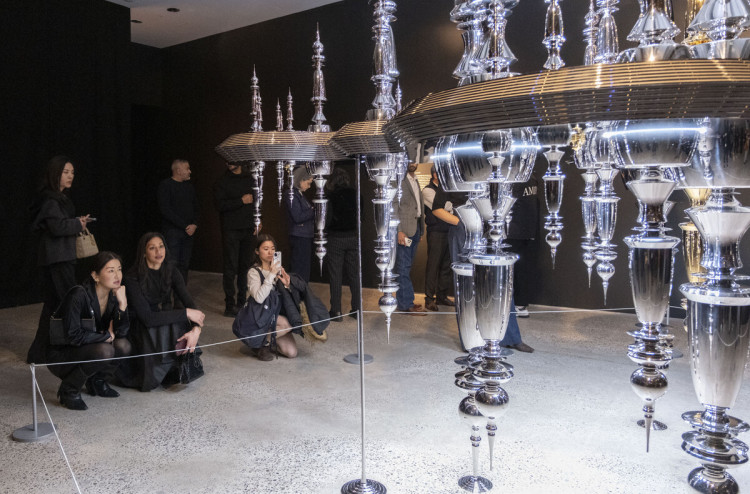
Ranbir Sidhu No Limits: Opening Celebration. Artwork pictured: Ranbir Sidhu, Odyssey, 2025. Stainless steel, 24-karat gold, fibre optics. Overall: 307.3 × 408.9 × 261.6 cm (121 × 161 × 103 in.) © Ranbir Sidhu. Photo: Leah Maghanoy
From a fortuitous meeting between artist and curator to its public opening in January, Ranbir Sidhu: No Limits has taken an unusual path to the AGO. That’s only fitting, because everything about this exhibition of monumental sculptures is unique. When viewers enter the Signy Eaton Gallery, they will discover works of extraordinary scale, fabricated with unexpected materials and reflecting the artist’s fascination with design, engineering and the natural world.
Here, the AGO’s Deputy Director and Chief Curator Julian Cox discusses the exhibition, Ranbir Sidhu’s ambitious vision and the importance of presenting work by a local artist with global appeal.
Q: How did you first come in contact with Ranbir and his art?
A: I met Ranbir in 2023 at an AGO function for KAWS: FAMILY. He was invited through RBC, which was the lead sponsor of the exhibition, and he was one of many guests we toured through the show. He was very engaged and shared a little about his art, so that prompted a series of conversations. I went to see a sculpture he’d made for a private client , and that allowed me to get a sense of his mastery of materials and for him to discuss his approach to design and fabrication. At that point I got quite engaged and we spoke about the potential for a project of some kind. A few months later I went with a team of talented AGO folks to a warehouse in Vaughan to see his prototype for Asteroid 3033 X1 (2025). It was quite different to what it is now, but Ranbir talked us through how he wanted to expand his vision for it towards a possible presentation at the AGO. From there, we co-conceived what the exhibition would be and how we could optimize the Signy Eaton Gallery with a cluster of artworks that would complement each other and embody Ranbir’s practice.
Q: What was it like to see this project evolve from concept to installation?
A: More than any other AGO project that I’ve been involved in, this was really a leap of faith. You can imagine what you want to do, but at some point you’ve just got to take the jump and do it. There were a few works Ranbir discussed, but we zeroed in on Asteroid 3033 X1 (2025), Odyssey (2025) and Fortress of Memory (2025). They each address aspects of Sikh heritage and culture in ways that were meaningful to Ranbir as an artist and could be accessible to a broad audience. A major motivator for me was the fact that, outside of the Punjab in India, and the United Kingdom, the largest homes for the Sikh diaspora are here in Ontario and in British Columbia. I wanted to find a way to celebrate an artist that is embedded within that community.
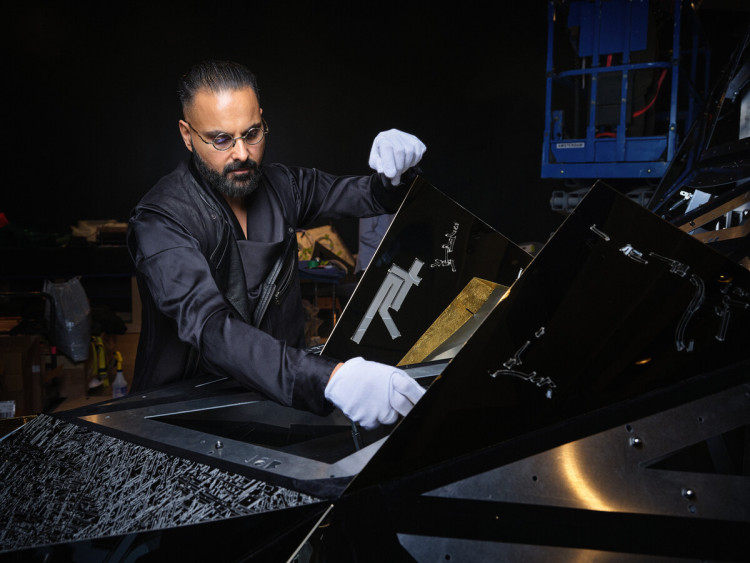
Artist portrait, Ranbir Sidhu. Work shown: Asteroid 3033 X1, 2025. Stainless steel, aluminum, gold foil, fibre optics, LED, crystal. Overall: 365.8 × 388.6 × 779.8 cm (144 × 153 × 307 in.) © Ranbir Sidhu. Photo: Craig Boyko
Q: What makes Ranbir’s use of materials so unique?
A: The way he uses materials is rooted in the proximity he’s had to manufacturing environments throughout his life, where making, testing, and problem-solving were part of his everyday experience. Being around fabrication spaces from a young age gave him an intuitive understanding of how materials behave, how metal can be shaped, stressed, refined, and transformed. A lot of his practice is built on experimentation; trying unfamiliar processes, combining techniques, learning from machinists and engineers, and continually expanding his technical vocabulary to realize ambitious ideas. This approach was significantly advanced with support from the National Research Council of Canada, which enabled Ranbir to invest more deeply in research-driven material experimentation. The result is that his work operates simultaneously as art, engineering, and material inquiry, where fabrication methods and material science are in dialogue with form, history, and the natural world. For example, Asteroid 3033 X1 consists of over 1,500 fabricated and machined components, meticulously assembled into a unified structure. The overall form is inspired by the crystalline geometry of azurite, although the work doesn’t reference meteorites directly. The connection appears in the etched inset panels, which draw from Widmanstätten patterns—the crystalline structures found in iron meteorites as a symbolic and textural language. These references are a bridge between natural formation, deep time, and human-made precision. Ranbir’s work is also informed by travel and exposure to diverse geologies, landscapes, and architectural histories, and by absorbing these varied influences he’s able to synthesize material, process, and concept into sculptures that are technologically advanced and timeless.
Q: What would you like viewers to take away from this exhibition?
A: Its very title, No Limits, aptly communicates Ranbir’s mentality. He really wanted to push boundaries with this project, and it was a huge learning experience for him and for the AGO. I’m very proud that we’re hosting the debut exhibition of an artist from within our own community, whose artistic language and vocabulary is so ambitious and truly global. Ranbir has referred to the works in the exhibition as being both a memorial and an offering—a tribute to endurance, resilience, and the ethic of seva (Sanskrit for “selfless service”), qualities that continue to resonate as part of a larger cultural memory. If people take some of those aspects away, I will feel like we’ve done our jobs.
Want to learn more? Ranbir Sidhu shares his own perspective in this Foyer article.