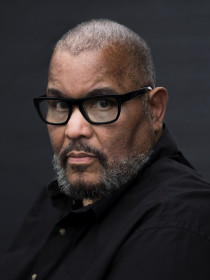
Titus Kaphar in Conversation with Jason Stanley
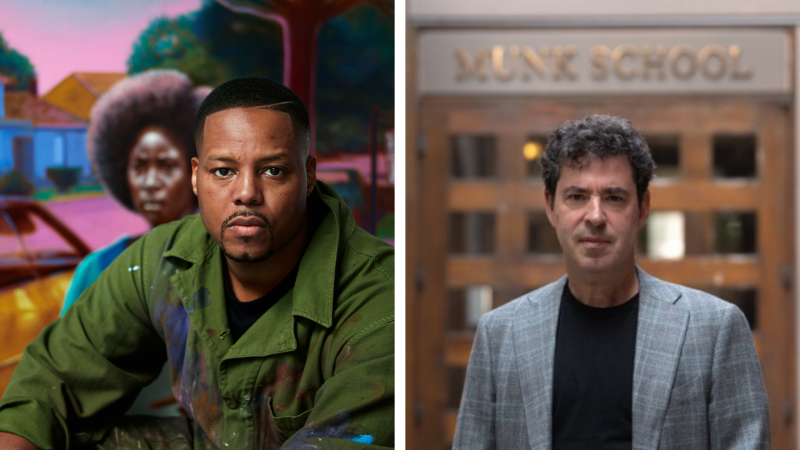
(Left) Titus Kaphar. Photo: Mario Sorrennti. (Right) Jason Stanley
Titus Kaphar in Conversation with Jason Stanley
Join artist Titus Kaphar in conversation with Professor Jason Stanley for an in-depth discussion about Kaphar's artistic practice.
Painter, sculptor, filmmaker, and installation artist Titus Kaphar confronts history by dismantling classical structures and styles of visual representation in Western art in order to subvert them. Dislodging entrenched narratives from their status as “past” so as to comprehend their impact on the present, he exposes the conceptual underpinnings of contested nationalist histories and colonialist legacies and how they have served to manipulate both cultural and personal identity.
Through the deconstructive techniques of cutting, shredding, stitching, binding, and erasing both subject and support, Kaphar reconstructs new codes and modalities, reckoning on Black possibilities. In Yet Another Fight for Remembrance (2014), he used thick white brushstrokes to obscure the gesturing bodies of a group of African American men in the “Hands up, don’t shoot” position, and then repainted their outlines in black to reassert their formal presence. Thus the painting process itself became the embodiment of the ongoing struggle for social visibility and recognition. During his 2017 TED Talk, Kaphar performed, onstage, the whitewashing of his large-scale painting Shifting the Gaze (2017). Based on Frans Hals’s Family Group in a Landscape (1645–48), which portrays a wealthy Dutch family and their African servant, Kaphar’s version eclipsed the family group with white paint, shifting attention entirely to the presence of this young servant.
Kaphar’s art addresses salient social and political concerns, but it also springs from his own life story. For example, his encounter with his estranged father, Jerome, has led to an ongoing multimedia exploration of the criminal justice system called The Jerome Project (2014–). This series of portraits began with Kaphar’s online discovery of the mug shots of ninety-seven African American men who shared his father’s first and last names. He paints gilded portraits of each man in the style of Byzantine devotional icons, and then dips them in tar. Initially, the depth to which each painting was immersed in tar corresponded to the time that each subject had spent behind bars; in later paintings, this has increased to represent the longer-term implications of social silencing that results from their incarceration.
Jason Stanley is a philosopher. He holds the Bissell-Heyd Chair in American Studies in the Munk School of Global Affairs & Public Policy, and also has an appointment in the Department of Philosophy. The author of seven books and dozens of scholarly articles in multiple disciplines, Jason also writes for a broader audience on the themes of authoritarianism, propaganda, free speech, mass incarceration, and democracy, most frequently for The New York Times, The Guardian, and Project Syndicate. Jason has also published in The Washington Post, Die Zeit, Frankfurter Allgemeine Zeitung, Folha de São Paulo, El Pais and many other outlets across the world. A New York Times bestselling author, Jason’s work has been translated into over 25 languages.