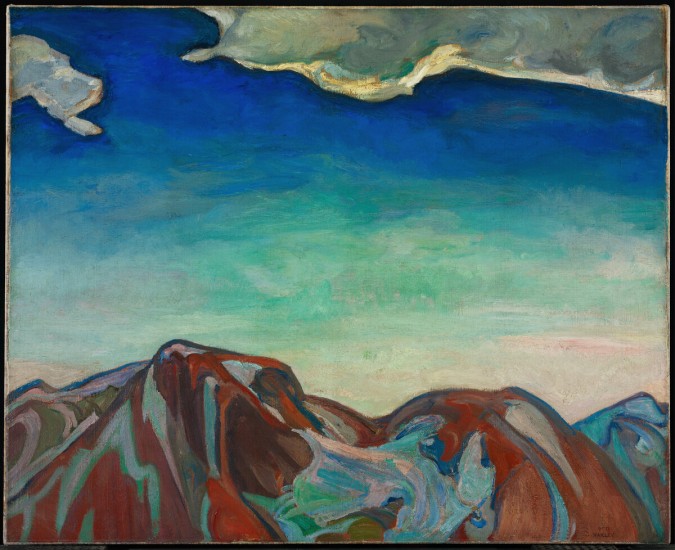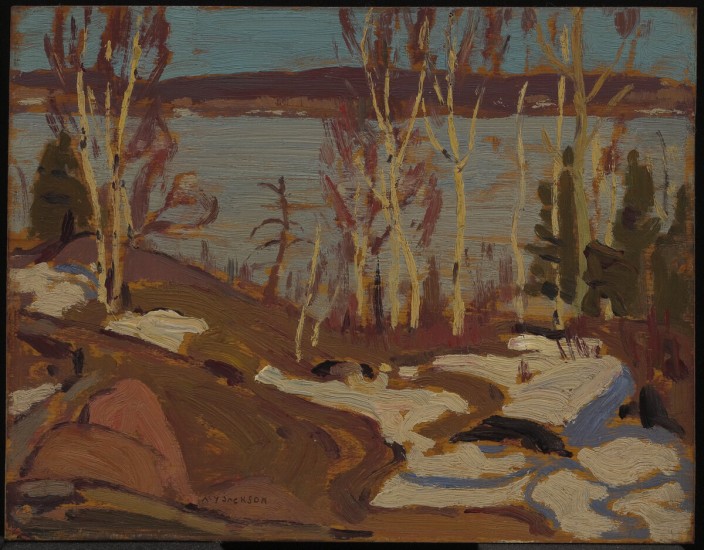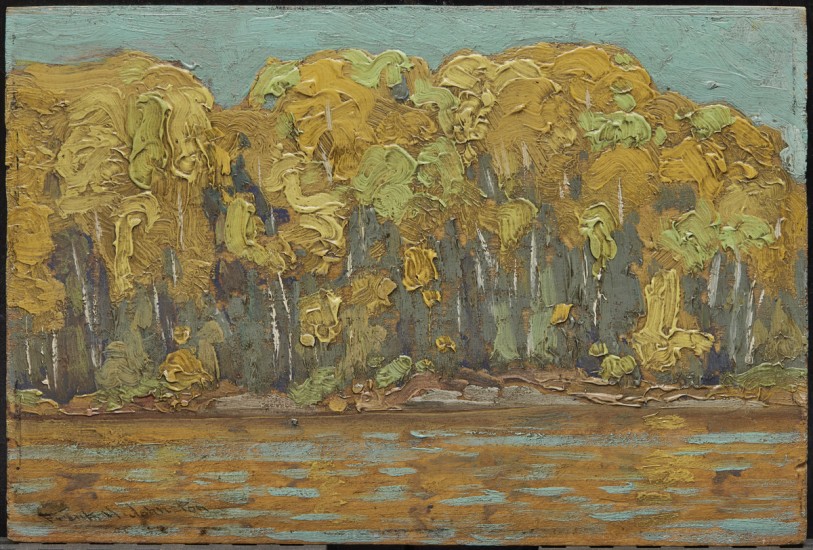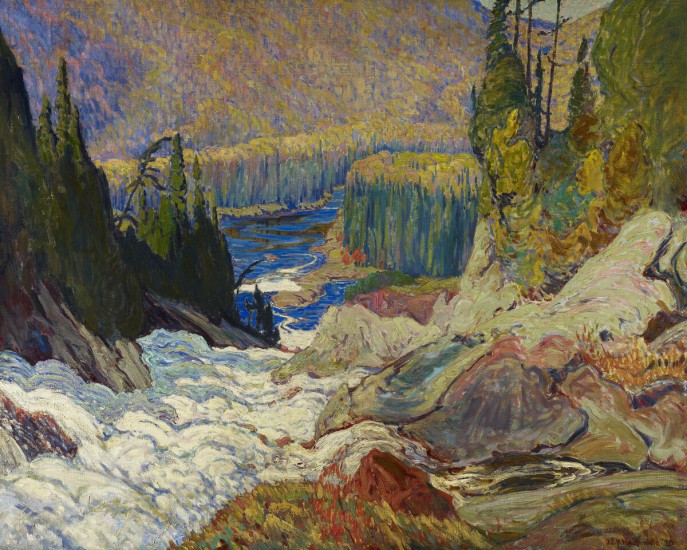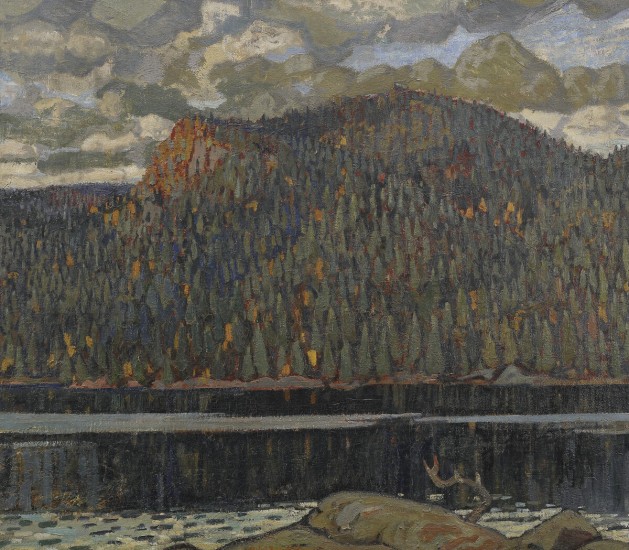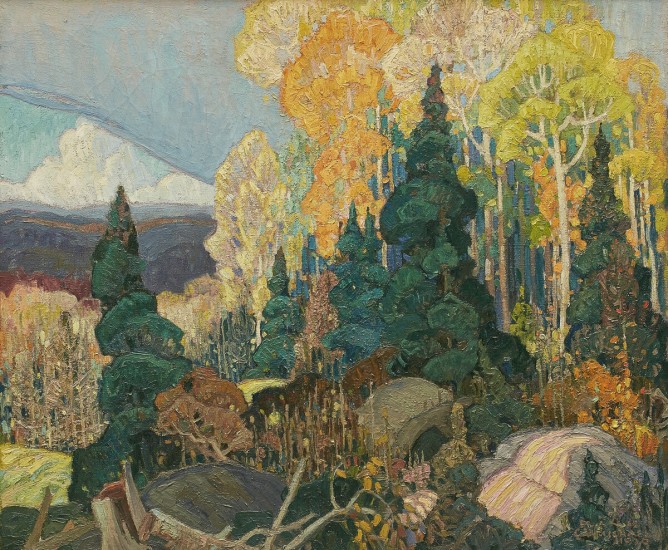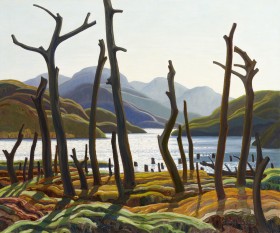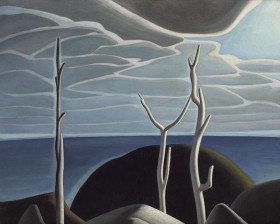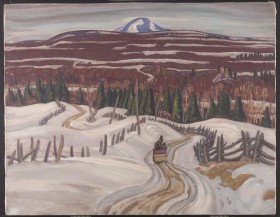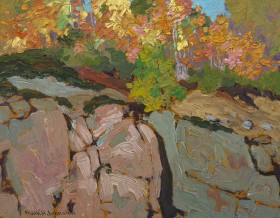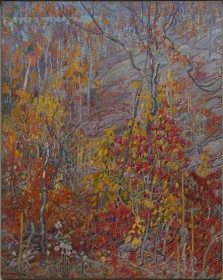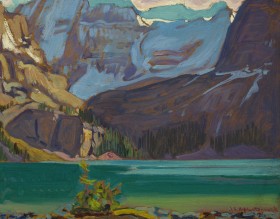
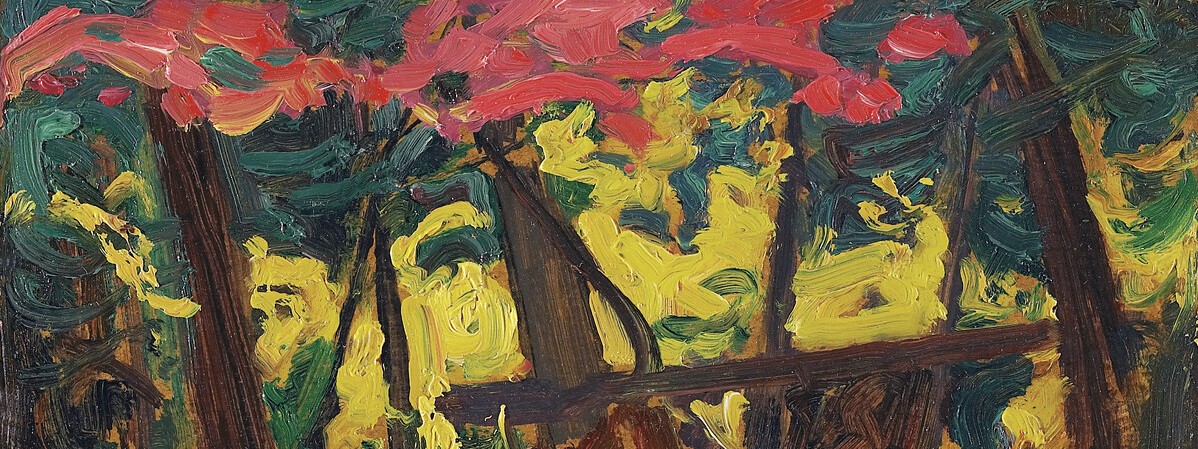
J.E.H. MacDonald. Tangled Bush, Algoma, 1919. Oil on paperboard, Overall: 21.5 x 26.6 cm. The Thomson Collection at the Art Gallery of Ontario. Photo © AGO. 2004/28
The Group of Seven has been a foundational part of the AGO since 1920, when the museum hosted their inaugural exhibition. Their works imagine, in paint, a country of ancient lakes and woods, Arctic vistas, and the magic of the northern lights.
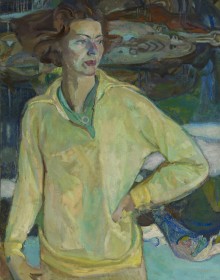
Today, their artistic vision is on full view. Signature works by all members of the Group of Seven, and the artists associated with them, are located on Level 1 and in the Thomson Collection of Canadian Art on Level 2. A walk through the museum offers visitors the opportunity to fully immerse themselves in the Group, to see sketches and finished oils side by side, and to gain an appreciation for the Group’s peers, including Emily Carr, Yvonne McKague Housser, Lionel LeMoine Fitzgerald, Sarah Roberston, and Tom Thomson.
The Group’s legacy is their art, their ambition, and the opportunities they created for other artists across the country. They have inspired generations of artists who have both celebrated and responded critically to the Group’s mythic vision of Canada. The AGO highlights their enduring spirit through research, collection building, publishing, and exhibitions.
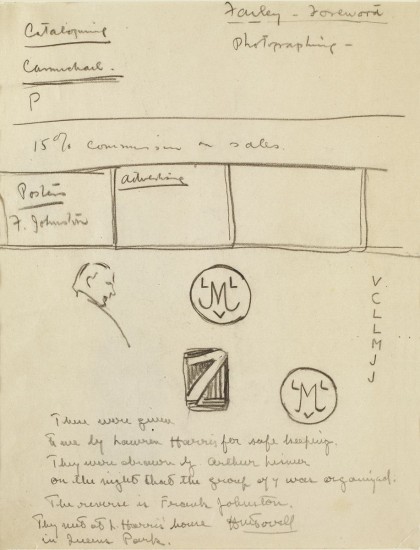
In the early 1910s, Ontario artists Franklin Carmichael, Lawren Harris, A. Y. Jackson, Franz Johnston, Arthur Lismer, J. E. H. MacDonald, and F.H. Varley began painting, both alone and together, in the rural outskirts of Toronto. Over time, they headed north to paint Algonquin Park, the Anishinaabe Algonquin Nation's unceded territory and Ontario’s first provincial park, and to the Algoma region on the north shore of Lake Superior, territory of the Anishinaabe, addressed by both the Robinson-Superior Treaty (1850) and the Robinson-Huron Treaty (1850).
Breaking from the traditional Academic painting styles of the time, their shared ambition was to pursue a more expressive, experimental art—one that was distinctly Canadian. Their romanticized renderings of nature rarely include imagery of humans. In their quest for authentic and spiritual experiences within nature, they positioned Canada as an unspoiled, uninhabited country despite the presence Indigenous communities and industry throughout the regions they visited.
Interrupted by the first World War and personal tragedies, it was not until 1920 that these artists came together in Toronto to exhibit their work under the name Group of Seven. The Group remained active throughout the 1920’s exhibiting across Canada and internationally. The Group evolved and officially disbanded in 1933, but their ambition and the beauty of their work has made them enduring symbols of Canada.
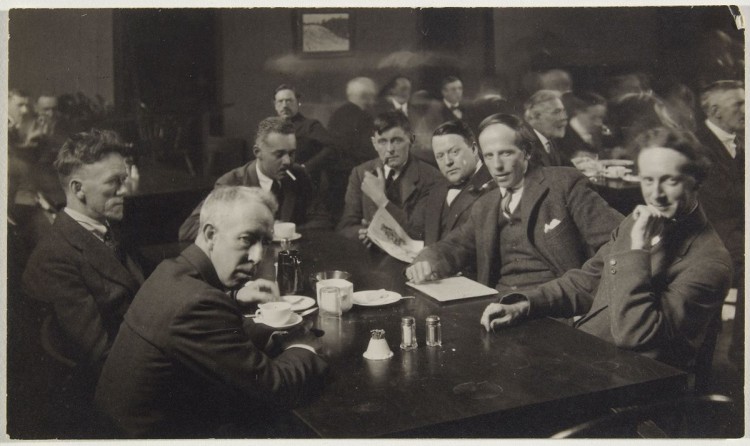
Arthur Goss, Luncheon at the Arts and Letters Club, Toronto. (A.Y. Jackson, F. Varley, L. Harris, Barker Fairley, F. Johnston, A. Lismer, J.E.H. MacDonald), c.1920. gelatin silver print, Overall: 9 x 12.2 cm. Art Gallery of Ontario. Transferred from the E.P. Taylor Research Library and Archives, Art Gallery of Ontario, 1996. 96/59
An artist often tied to the Group of Seven, Tom Thomson was friend, colleague, and artistic inspiration to many of the Group. Born in Claremont, Ontario, in 1877, he was a keen woodsman. After working as a commercial artist in Seattle and Toronto, from 1913–17, Thomson spent most of his time in Algonquin Park, creating vivid oil sketches.
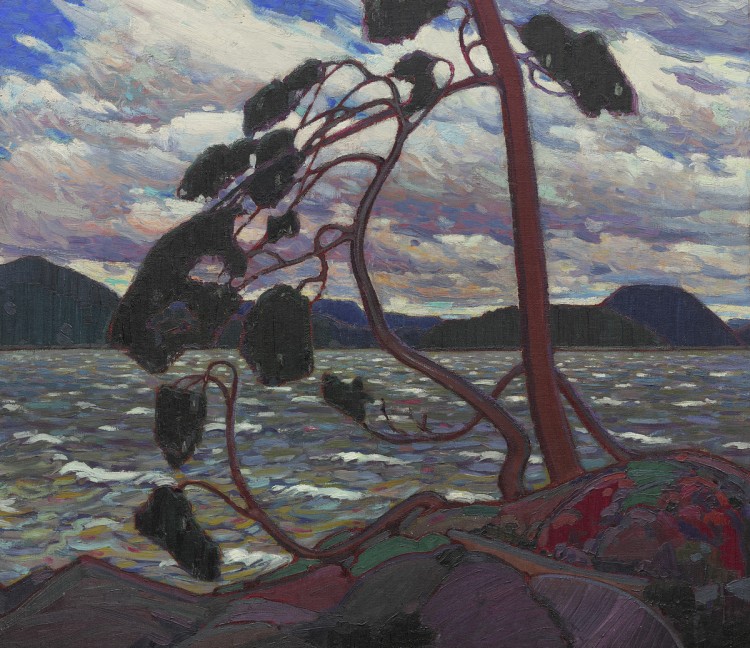
Tom Thomson. The West Wind, Winter 1916-1917. oil on canvas, Unframed: 120.7 × 137.9 cm. Art Gallery of Ontario. Gift of the Canadian Club of Toronto, 1926. © Art Gallery of Ontario. 784
Thomson’s skill as a designer permeated his paintings, and his naturalistic treatment of the landscape comes alive through an expressive use of colour, and freer forms. His remarkable career was cut short in 1917 when he drowned in Algonquin Park, three years before the Group’s first exhibition. While he never received any significant recognition during his lifetime, his major canvases, including the AGO’s own The West Wind (1916–1917) and luminous oil sketches, entered public collections shortly after his death. His work, and the many myths surrounding his death, have made him a Canadian icon.
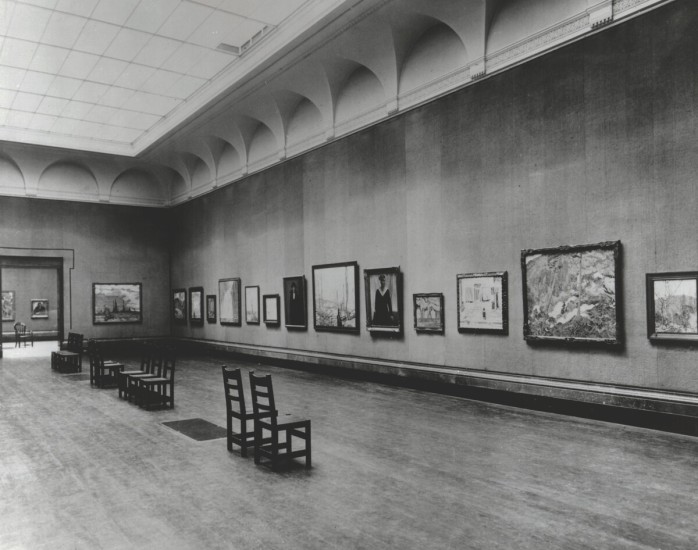
A historic moment in the development of the AGO, the Group of Seven’s debut exhibition on May 7, 1920 was the first exhibition in Canada to be labeled “art for a nation.” Only a few months prior, the museum had hosted a memorial exhibition commemorating the work of Tom Thomson.
Among the 121 works exhibited by the founding members of the Group (Franklin Carmichael, Lawren Harris, A.Y. Jackson, Franz Johnston, Arthur Lismer, J.E.H. MacDonald, and F.H. Varley) were bold Algoma-inspired landscapes, portraits, urban scenes, garden views, and works produced for Canadian War Memorials.
At the time, critics were less than sure about the Group. The Canadian Courier asked, “are these new Canadian painters crazy?” while The Toronto Star could only concede that “these seven painters show some excellent work.” They persisted and ventured, full of pictorial ambition, until the mid-1930s, bringing attention to their modern view of Canada and the importance of art in all aspects of society.
Throughout the Group's existence, the AGO remained one of their largest proponents, hosting eight exhibitions between 1920 and 1931.
The influence of the members of the Group of Seven on the AGO was not limited to their artistic contributions. Throughout the first half of the 20th century, its members contributed to the AGO in many ways.
A pioneer in art education, Arthur Lismer launched a highly successful Saturday morning art class for children at the AGO in 1929. Demand was such that children lined up around the block. In these classes, Lismer, and the instructors he supervised, would encourage students to express themselves instead of just copying the works and techniques of the instructor. Following the success of these Saturday morning classes, Lismer went on to create the Children’s Art Centre at the Art Gallery of Toronto in 1933.
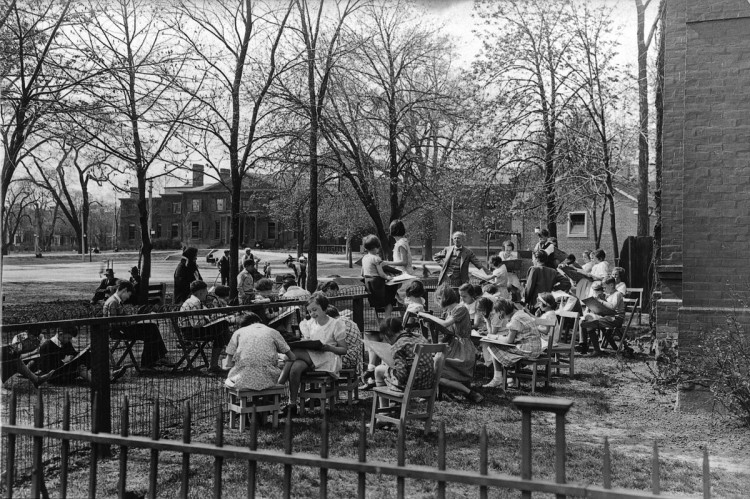
Arthur Lismer conducting a children’s outdoor sketching class in Grange Park in 1934. Edward P. Taylor Library & Archives, Art Gallery of Ontario. Photo © AGO.
A.Y. Jackson was a devoted supporter of artists during his lifetime. A Montrealer, he helped bring together artists of Quebec and Ontario and in 1933, he founded the Canadian Group of Painters which included former Group of Seven members Lawren Harris, A.J. Casson, Arthur Lismer, and Franklin Carmichael. His connection to the AGO goes deeper than exhibiting here. Throughout the 1940s and 50s, he and fellow artists A.J. Casson and Frances Loring served on the Gallery’s Acquisitions Committee, helping advocate for works by progressive Canadian artists to be acquired, such as Edna Taçon’s Improvisation No 2 (1947), a non-objective painting deemed by many to be radical at the time, and Paraskeva Clark’s Swamp (1939).
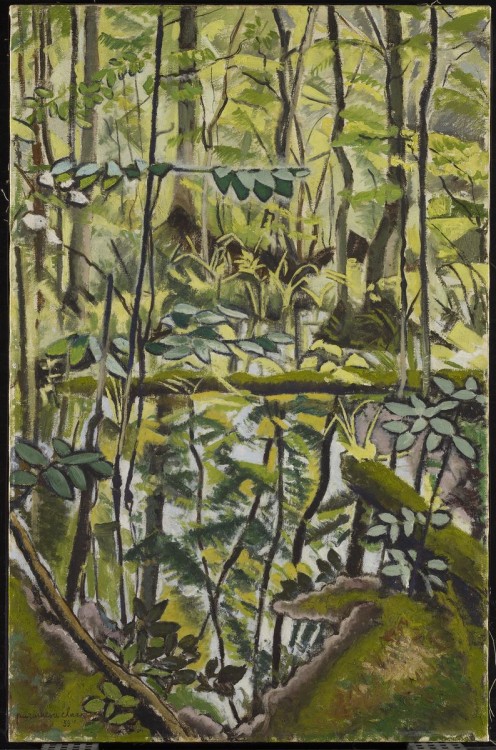
Paraskeva Clark, Swamp, 1939. Oil on canvas, Overall: 76.2 x 50.8 cm. Art Gallery of Ontario. Gift from the Albert H. Robson Memorial Subscription Fund, 1939. © Clive H. Clark. 2535
To learn more and to find related publications including Canadian Art: The Thomson Collection at the Art Gallery of Ontario, visit shopAGO or the Edward P. Taylor Library & Archives.